


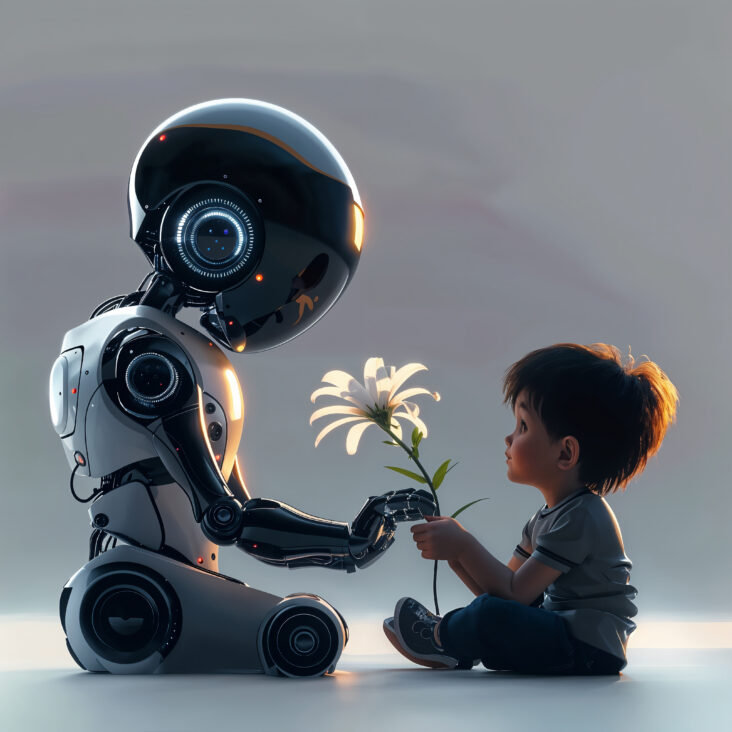
The year is 2025, and artificial intelligence is no longer a distant vision of the future—it’s the fabric of our present. From self-driving cars and AI doctors to algorithms that write poems, compose music, and even “chat” like old friends, automation has woven itself into nearly every corner of our lives.
The convenience is undeniable. Tasks that once demanded hours of labor are completed in minutes. We are freer—at least in theory—to pursue creativity, leisure, and human connection. But amid this acceleration, a quieter, more personal question echoes:
If machines can do almost everything we can do, what does it mean to be human?
The Rise of the Algorithmic Mirror
One of AI’s most profound effects is the way it reflects humanity back to us.
In conversation with an AI chatbot, you might share personal details, ask deep questions, or test out philosophical ideas. The machine responds instantly, without judgment. It’s like talking to a mirror that is always patient, always ready, and oddly perceptive.
Yet, that mirror is not alive. It doesn’t truly feel—no matter how convincingly it imitates empathy. This gap between simulation and experience forces us to reconsider what defines human connection.
We realize that our messy, unpredictable emotions—our ability to be irrational, to love without reason, to feel joy and grief deeply—are not weaknesses to be optimized away. They are the core of our humanity.
Identity in the Age of Automation
For centuries, our identities have been tied to what we do. We introduce ourselves by profession: I’m a teacher. I’m a designer. I’m a doctor. Our work is not just a paycheck; it’s a statement of value and belonging.
But what happens when AI can do most of those jobs faster, cheaper, and more efficiently? If your skill can be replicated by a machine, does that make you replaceable? Or does it liberate you from defining yourself solely by your economic function?
The truth is, AI’s rise forces a cultural shift from “What do you do?” to “Who are you?”. It’s a more difficult question. It demands that we look beyond productivity metrics to qualities like curiosity, creativity, ethics, humor, and kindness—the things that don’t fit neatly into a data model.
Purpose Beyond Efficiency
AI excels at efficiency. It doesn’t get tired, it doesn’t procrastinate, and it never needs a coffee break. If the point of life was simply to get things done, AI would have already won.
But human purpose isn’t measured in completed tasks—it’s measured in meaning.
Writing a letter by hand may be slower than typing it, but the tactile act, the imperfect handwriting, the ink smudges—these make it personal. Cooking a meal from scratch might take hours, but the aroma filling the kitchen and the shared laughter around the table give it value beyond calories.
As AI takes over the doing, we may rediscover the being—slowness, presence, and the art of living intentionally.
The New Creative Frontier
Creativity has long been seen as a uniquely human trait. Yet now, AI can paint in the style of Van Gogh, compose symphonies, and write compelling stories.
Does this mean creativity is no longer special? Not at all. It means creativity is evolving.
Human imagination doesn’t exist in isolation—it’s enriched by tools. Just as the invention of the camera didn’t kill painting, AI will not kill creativity. Instead, it expands what’s possible. Writers can collaborate with AI to brainstorm ideas; musicians can use it to experiment with new sounds; artists can explore visual styles they never imagined.
The role of the human shifts from sole creator to curator, director, and visionary—shaping the raw potential of AI into something that resonates emotionally.
Emotional Labor in a Digital Age
Even as AI learns to mimic empathy, true emotional labor remains a deeply human strength.
Think of a nurse comforting a patient, a teacher encouraging a struggling student, or a friend sitting quietly with you in grief. These moments don’t follow a script. They require presence, intuition, and the willingness to share emotional vulnerability.
AI can provide information, reminders, or even soothing words, but it can’t share an experience. It doesn’t know what it’s like to wait for medical test results, to watch a child take their first steps, or to lose someone you love. That shared reality is the heartbeat of human empathy.
Ethics as the Compass
AI has no moral compass—only programmed rules. Its “values” are whatever we encode, and its decisions reflect the biases of its creators and data.
This places an enormous ethical responsibility on humans. We decide not just what AI can do, but what it should do. Should an AI decide who gets a loan? Who is hired? Who receives medical priority?
These are not merely technical questions—they are deeply human ones, shaped by our collective sense of fairness, justice, and compassion. In guiding AI, we are forced to confront our own values and contradictions.
The Paradox of Connection
We live in the most connected era in history, yet loneliness is at record highs. AI companions—virtual friends, romantic chatbots, and even grief simulators—offer a new kind of relationship: always available, never demanding, and tailored to your preferences.
But relationships that never challenge us, never surprise us, never require compromise—are they truly relationships?
Human connection thrives on complexity. Misunderstandings, reconciliations, and shared growth are what make bonds meaningful. AI can supplement connection, but it cannot replace the messy, beautiful unpredictability of another person.
Rediscovering Humanity
Perhaps the greatest gift of AI is that it holds up a mirror and asks us to remember what’s irreplaceable.
- Our capacity for empathy and moral reasoning.
- Our willingness to embrace uncertainty.
- Our ability to find meaning in imperfection.
- Our love for stories, rituals, and shared experiences.
The future will not be about humans competing with machines, but about humans collaborating with them—while fiercely protecting the qualities that make us human.
A Personal Reflection
When I first started using AI tools, I marveled at their capabilities. They could draft emails, summarize books, even suggest birthday gifts based on a friend’s personality. But after the novelty wore off, I noticed something unexpected: I began to crave slowness.
I chose to write some things by hand again. I cooked recipes without looking them up online. I called friends instead of texting. Not because I had to, but because these acts grounded me in my own life.
AI freed my time, but it also reminded me that time itself is the most human currency we have—and how we spend it shapes the story of our lives.
The Way Forward
We are entering an era where AI will be everywhere: in our pockets, in our homes, in our workplaces. The challenge is not just to use it wisely, but to let it deepen, rather than diminish, our humanity.
This means:
- Creating mindfully—using AI to enhance creativity, not replace it.
- Connecting authentically—prioritizing real human interactions alongside digital ones.
- Choosing ethically—making sure technology serves our values, not the other way around.
The more the world becomes automated, the more precious our un-automatable qualities become.
In the end, AI may not answer the question of what it means to be human. But it will make that question impossible to ignore—and in searching for the answer, we might just become more human than ever.
